A chelicera-bearing arthropod reveals the Cambrian origin of chelicerates

  A chelicera-bearing arthropod reveals the Cambrian origin of chelicerates Abstract Chelicerata is a megadiverse (over 120,000 species) arthropod clade that includes familiar taxa of profound ecological and economic importance, such as scorpions, spiders and mites 1 . Extant chelicerates share a unique anatomical character, the chelicerae—feeding first appendages terminated by a simple pincer-like chela 2 . The fossil record of these primarily predatory animals spans almost 500 million years 3 , suggesting a likely yet undocumented origin during the Cambrian Explosion. Artiopods 4 , 5 , 6 , megacheirans 4 , 7 , 8 , 9 , habeliids 10 , 11 , 12 , 13  and mollisoniids 14 , 15  have been considered Cambrian stem- or crown-group chelicerates, but they all lack unequivocal chelicerae, leaving the emergence of chelicerae-bearing arthropods unclear. Here we describe  Megachelicerax cousteaui  gen. et sp. nov., a large soft-bodied arthropod from the middle Cambrian of Ut...

Screening of antimicrobial activity in venom: Exploring key parameters


Screening of antimicrobial activity in venom: Exploring key parameters

Abstract

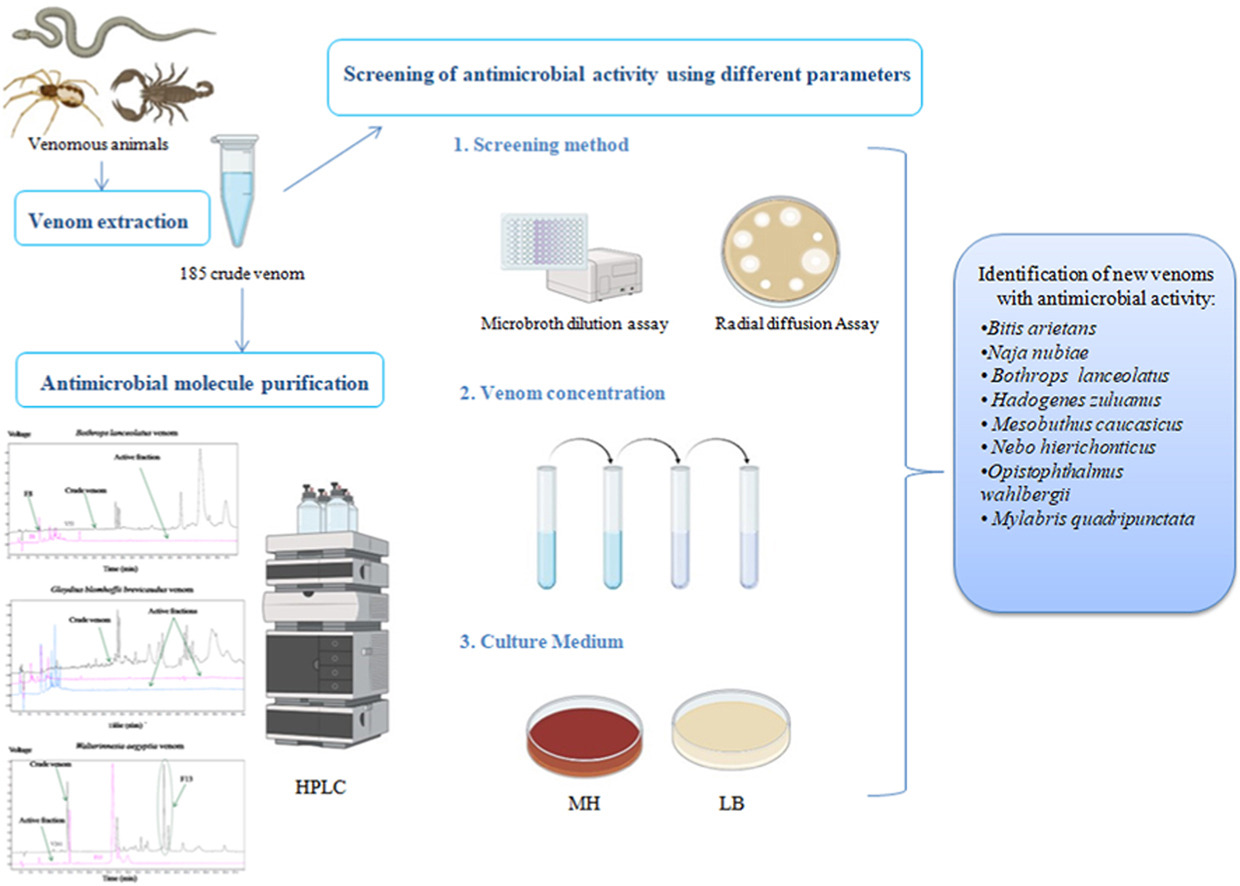
The escalating challenge of antibiotic resistance significantly threatens global health, underscoring the critical need for new antimicrobial agents. Venoms, increasingly recognized as reservoirs of bioactive compounds with diverse pharmacological effects, have been the focus of recent research. This work evaluates the use of various screening methodologies in assessing the antimicrobial activities of 185 venoms against some gram positive and gram negative bacteria, including E. coli ATCC 8739, B. subtilis ATCC 6633, P. aeruginosa ATCC 9027, and S. aureus ATCC 6538P species and explores the influence of settings on the findings. Furthermore, the research explored the possibility of purifying antimicrobial molecules from venoms through HPLC. Several fractions demonstrated antimicrobial activity against the tested strains.
Our results reveal that the measured antimicrobial efficacy of venoms varies according to:i) venom concentration, ii) the detection method, including microdilution and radial diffusion assays, and iii) the choice of culture medium, specifically LB or MH.
This strategy has allowed us, for the first time, to identify antimicrobial activity in: i) Bitis arietans venom against P. aeruginosa ATCC 9027, ii) Naja nubiae and Bothrops lanceolatus against B. subtilis ATCC 6633, P. aeruginosa ATCC 9027, and S. aureus ATCC 6538P, and iii) Hadogenes zuluanus, Mesobuthus caucasicusNebo hierichonticus, Opistophthalmus wahlbergii scorpions, and Mylabris quadripunctata beetles against S. aureus ATCC 6538P.
These findings highlight venoms potential as effective antimicrobial resources and improve our understanding of key factors critical for an accurate detection of venoms antimicrobial properties.
Ouertani, A., Mollet, C., Boughanmi, Y., De Pomyers, H., Mosbah, A., Ouzari, H., Cherif, A., Gigmes, D., Maresca, M., & Mabrouk, K. (2024). Screening of antimicrobial activity in venom: Exploring key parameters. Toxicon, 108135. https://doi.org/10.1016/j.toxicon.2024.108135